
No energy despite normal labs?
There may be a root cause the standard panel can’t pick up.
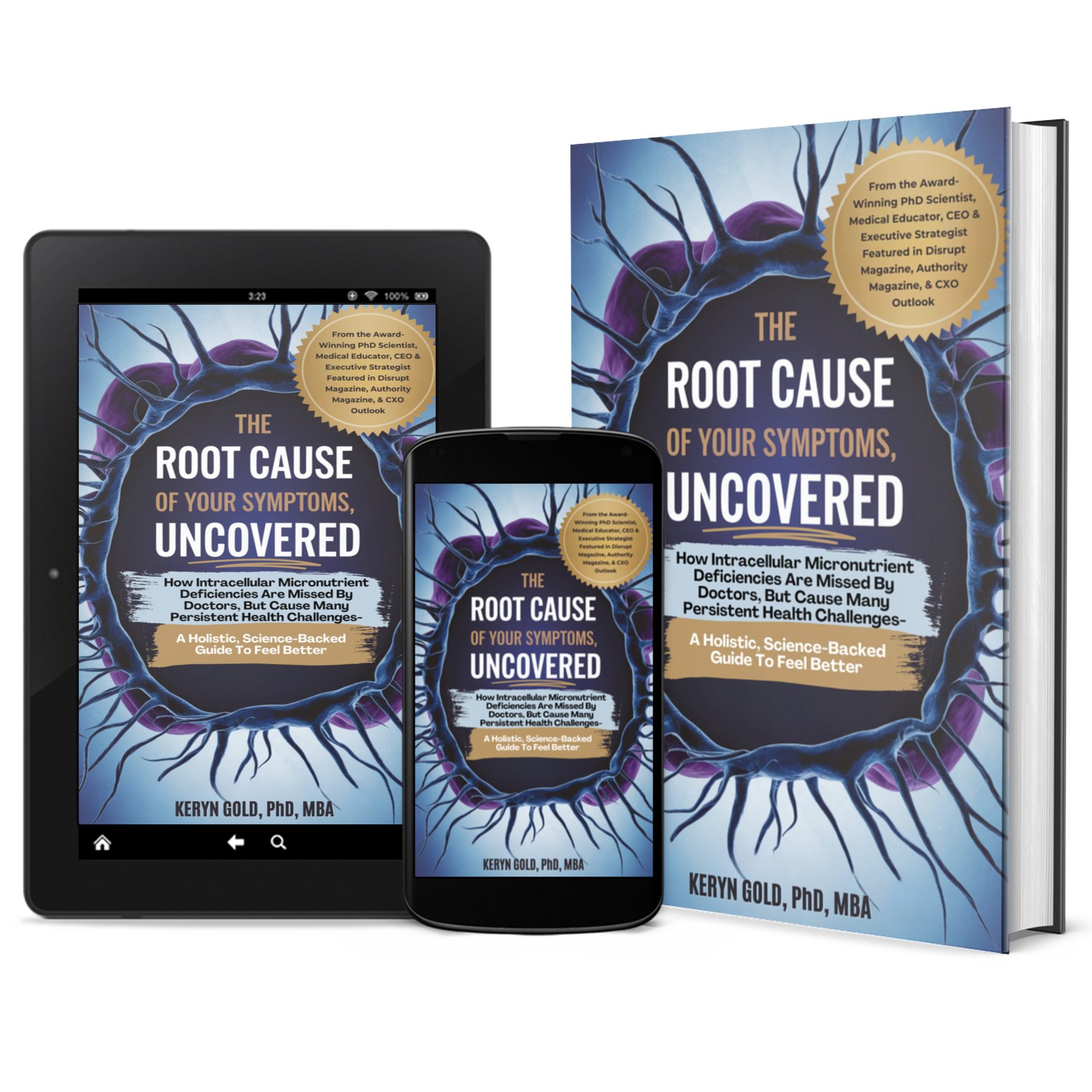
The Root Cause of Your Symptoms, Uncovered
by Keryn Gold, PhD, MBA
Why it matters
A reference range describes what’s common in the population a lab measured. It isn’t a target, and “normal” isn’t the same as optimal for you.
That gap isn’t a conspiracy, and it isn’t your doctor missing something. It’s a default order set doing exactly what it was designed to do. Standard panels answer the questions they were built to answer.
This book covers what sits outside those panels: which markers answer which question, what quietly drains nutrients, and what to bring to your next appointment so the visit is worth the copay.
What if you had actionable answers to your most pressing questions?
Why am I still exhausted?
What a reference range actually is, and the one question worth asking before any test.
Which tests should I ask for?
The three compartments, which marker answers which question, and what to bring to the appointment.
Could my medication be causing this?
The medications and conditions that deplete nutrients, laid out in one table you can check.
Should I just take a multivitamin?
Documented toxicity and interactions, and what to rule out before spending a dollar.
Pick how you want to read it
Every format is an instant download, yours to keep, and you can re-download it any time.
What’s inside
Seven parts. Start wherever your problem is, because every chapter stands alone.
Part One: Why you feel bad when the labs look fine
- Why do I feel awful if my bloodwork came back normal?
- What is actually being measured, and what isn’t?
- Why can’t I just fix the one thing I’m low in?
Part Two: What’s draining you
- Which medications and conditions quietly drain nutrients?
- Why isn’t a good diet enough?
Part Three: Getting real data
- Which tests are real, which are investigational, and what should I actually order?
Part Four: Cutting through the supplement noise
- What absorbs, what doesn’t, and what the front of the bottle leaves out
- Documented toxicity thresholds and interactions
Part Five: Start from your symptom
- A symptom map, plus 14 visible signs and which ones earn a test
- Rows for GLP-1 users, perimenopause, postpartum and plant-based eaters
Part Six: Running it
- Timing, spacing and order, including what to take apart from what
- The Nutrient Files: 33 nutrients, 11 uniform fields each
Part Seven: When nobody can name it
- Still sick months after an infection: long COVID and ME/CFS
- Joints, heart rate and reactions that seem connected: POTS, hEDS and MCAS
Whether this is your book
It says plainly where the evidence is strong and where it isn’t. Here’s the short version, up front.
It may help if
- Your labs came back normal and you still feel wrong
- You’re on a long-term medication and nobody has mentioned depletion
- You want to know which test answers which question before you pay for one
- You’d rather bring a specific question to your next appointment than a list of symptoms
It’s the wrong book if
- You have a symptom that needs urgent medical care
- You want a protocol to follow instead of questions to ask
- You’re looking for a supplement list rather than a way to find out what you need
- You want certainty where the research doesn’t offer any
Who wrote this
Keryn Gold, PhD, MBA. PhD in Biomedical Sciences and Statistical Genetics from Washington University in St. Louis, where she started college at 14 and graduated summa cum laude at 17.
She spent 15+ years building the analytics, data science and health economics teams inside the largest healthcare organizations. That’s where she learned which questions the system is built to answer, and which ones it isn’t.
She finds the outside-the-box solutions most people don’t have visibility or access to.
Questions people ask before they buy
Is this going to tell me to buy supplements?
Does it name specific lab tests, and do you profit from that?
Do I need to read it front to back?
What files do I actually get?
Is this a substitute for seeing a doctor?
If you had your energy back tomorrow, what’s the first thing you’d spend it on?
That answer is the reason this book exists.
Educational content. Keryn Gold holds a PhD in Biomedical Sciences, not a medical license. Not medical advice.