
HEALTH
Told there’s nothing more they can do for your pain?
There’s usually a solution, just one there wasn’t visibility to before.
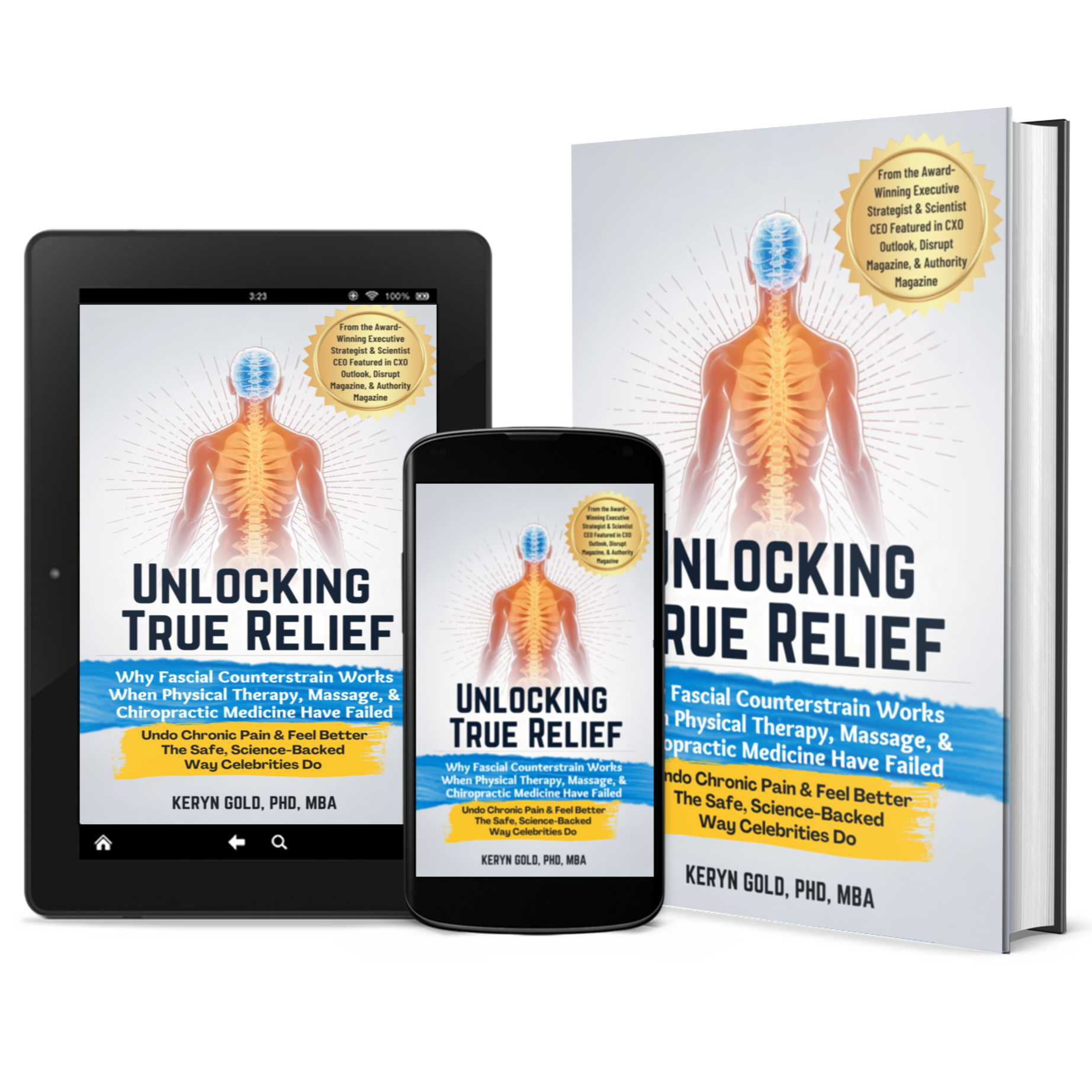
Unlocking True Relief: Fascial Counterstrain
by Keryn Gold, PhD, MBA
Why it matters
In 2023, about 1 in 4 US adults lived with chronic pain, according to the CDC. For many of them, it isn’t the pain so much as everything that grows around it. The plans that quietly stop getting made. The things that used to be an easy yes.
I know, because I lived with knee pain for 20 years. Somewhere along the way I stopped calling it a problem and started calling it my knee.
Then a friend mentioned a technique I’d never heard of. I’m a scientist, so I read the research first. It was thinner than the enthusiasm around it, and more interesting than I expected. I booked one appointment anyway, because the downside was one appointment.
The knee pain resolved after that first visit. Within weeks I was playing sports again. Longstanding back pain resolved later, too.
I’m one person, and one person isn’t evidence. So this book walks you through what the trials found, including the ones that found no difference, where the evidence is thin, and what would change my mind.
If you haven’t heard of Fascial Counterstrain, that’s not on you or your clinicians. Specialists go deep, and that’s what makes them good. The systems that surface treatment options only surface what’s already inside them. I wrote this so the next person doesn’t have to wait 20 years for visibility or access to it.
This isn’t another way to manage pain. It’s an option aimed at what may be the root cause, in a way you likely haven’t had visibility or access to previously, with the honest evidence and the questions to ask before your next appointment.
Asking any of these?
Each one has an answer you can act on before your next appointment.
Do I have to live with this?
What imaging is very good at, the zone where it goes quiet, and the question to ask before your next appointment.
Is there anything left to try?
A layer standard care often isn’t set up to reach, what a session does about it, and what to expect walking in.
Is there actual research behind this?
The controlled trials, including the ones that found no difference, the case reports, and exactly where the evidence is still thin.
How long before I feel a difference?
One objective test to run at home, and what a real change looks like when it happens.
Pick how you want to read it
Every format is an instant download, yours to keep, and you can re-download it any time.
What’s inside
Ten chapters. Each one is a question you may have already asked.
Also inside: what to expect after a session, including soreness, what helps between sessions, and how it compares with massage, myofascial release and craniosacral therapy. Plus a Quick Answers section.
Part One: What is actually happening
- Why has everything I’ve tried been a temporary solution at best?
- What is fascia, and why would it be the thing generating pain?
- What is Counterstrain, and what actually happens in a session?
Part Two: What the evidence actually says
- What does the research show, and where is it thin?
- What has it been used for, and what is it not for?
Part Three: Getting care without wasting money
- How do I find a practitioner and not waste the first session?
- How many sessions, what does it cost, and when do I stop?
Part Four: Beyond Counterstrain
- What else has real evidence that I can start without a practitioner?
- Does how you breathe actually change your pain?
- What if I want to learn this and treat people?
Whether this is your book
Chapter 5 is about when this is the wrong answer. Here’s the short version, up front.
It may help if
- Your pain keeps coming back after treatment that worked for a while
- Imaging came back unremarkable and nobody can name a cause
- You want to know what the research says before you book anything
- You’d rather resolve it than manage it
It’s the wrong book if
- You have a red-flag symptom that needs urgent medical care
- You want a guarantee rather than an honest read of the evidence
- You want to see someone for maintenance visits every week
- You want testimonials rather than trials
Who wrote this
Keryn Gold, PhD, MBA filed her knee pain under things you live with for 20 years. One appointment changed that. She wanted the next person to have the visibility and access she didn’t have for two decades, along with an honest map of what the evidence does and doesn’t show.
She finds outside-the-box solutions most people don’t have visibility or access to, and crafts them into something better that can benefit more people.
PhD in Biomedical Sciences and Statistical Genetics from Washington University in St. Louis, where she started college at 14 and graduated summa cum laude at 17. MBA. She built the data science and health economics and outcomes research centers of excellence for some of the largest healthcare organizations in the country. That’s where she learned how treatment options reach people, and how they don’t.
At home, she’s outnumbered by her husband, her son, and 2 rescue dogs, one of whom treats a sunny spot on the floor as a full-time job.
Questions people ask before they buy
What is Fascial Counterstrain, in plain English?
Is this a medical treatment guide?
Does Fascial Counterstrain actually have evidence behind it?
How do I find a Fascial Counterstrain practitioner?
How many sessions does it usually take?
What can I try while I look for a practitioner?
Is it normal to feel sore after a session?
I already see a physical therapist or chiropractor. Is this still useful?
What files do I actually get?
How is this different from buying it on Amazon?
If you didn’t suffer from chronic pain anymore, what is the first thing you’d do?
I couldn’t answer that for 20 years. I hope this book helps you find your answer, and I’d love to hear it.
Educational content. Keryn Gold holds a PhD in Biomedical Sciences, not a medical license. Not medical advice.